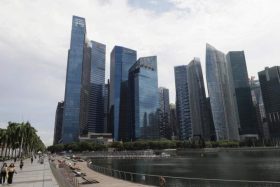
OFFICE rents in Singapore’s Central Region were hit hard during the last 3 recessions, with market declines lasting longer than the overall economic downturn and rents falling about 30 per cent from pre-recession rates, a new report shows.
Occupancy of offices in the Central Region also fell by 4.2 to 7 percentage points during the downturns, research by the National University of Singapore’s Institute of Real Estate and Urban Studies showed.

“While office rents appear to operate independently of economic fundamentals during good times, they respond to economic contraction in a similar manner as other variables like manufacturing output and employment,” IREUS reported on Thursday (June 30).
Looking at historical data, IREUS found little correlation between the office rents in the Central Region and gross domestic product (GDP). As firms are often locked in 3- to 5-year leases, they are unlikely to quickly move their offices in response to an economic downturn.

Singapore’s Central Region private sector office rents have risen quarter-on-quarter from 0.9 per cent in Q4 2021 to 1.6 per cent in Q1 2022, pointing to a recovery from the pandemic slowdown in the recent past.
A report issued on Jun 29 by JLL Singapore noted that Grade A office rents in Singapore’s Central Business District (CBD) were now 0.6 per cent below the pre-pandemic peak of S$10.81 per square foot (psf) per month in Q4 2019. According to JLL figures, Grade A CBD office rents rose 2.7 per cent to S$10.74 psf per month in the latest quarter, from S$10.46 in Q1 2022.
However, firms are still facing uncertainty in their office leasing decisions, said the IREUS report.
“If they respond to rate cuts and other signals of recession by reducing their physical space, they may be caught flat-footed if the global economy avoids a downturn and business proceeds as usual. In the other scenario where the economy takes a hard landing, they will then be under pressure to reduce cost if the demand for goods and services wane and business borrowing becomes more expensive due to higher interest rates,” Dr Lee added.
Given that hybrid working models are likely to stay for some industries, he expects firms to “expand moderately” while retaining a permanent space for core functions.
This version of article written by LISA KRIWANGKO and first appeared at The Business Times.
Photo: THE STRAITS TIMES